Turn this into a daily habit — free to start in the MindLift app:
You already know the list. Read a book. Take a bath. Call a friend. Go for a walk. Try a puzzle.
You've read that list before, probably while scrolling, and you did not get up and take a bath.
That isn't a discipline failure. It's a targeting failure. Every one of those suggestions assumes you're scrolling because you have nothing better to do — that doomscrolling is a boredom problem with a hobby-shaped solution. It usually isn't. It's a nervous system doing a job, badly, and no alternative activity will stick until it does the same job better.
So this list is sorted differently. Not by activity, by function — what the scroll is actually giving you. Find yours and the swap gets much easier.
First: what doomscrolling is doing for you
The research on this has gotten sharper recently, and it points somewhere specific: a 2026 systematic review of fourteen studies found doomscrolling consistently associated with depression, anxiety, psychological distress, sleep disturbance and lower wellbeing in young adults, with moderate effect sizes[1].
But the more useful part is the mediators. The mechanism doing most of the work between the scroll and the damage was intolerance of uncertainty — the same factor a separate review of fifty studies named as a core driver, alongside informational need and emotional discomfort[2].
That's the thing to sit with. You're not scrolling for entertainment. You're scrolling because something is unresolved, and the phone is the fastest thing in the house that pretends to resolve it.
The trap is that it almost works. Each swipe is a small promise that the next post will be the one that settles it. It never is, because the thing that's unsettled usually isn't in the feed at all. It's something in your life, and the feed is just adjacent to it.
There's a good illustration of this. Researchers ran a "kindness-scrolling" experiment — negative COVID news swapped for social posts about small acts of kindness, same scrolling format[3]. It stopped the mood damage that doomscrolling caused, but it didn't produce a wellbeing boost of its own — the researchers' own hypothesis that kinder content would outperform no content wasn't supported. Swapping what's on the screen doesn't fix it. The behaviour isn't about the content.
Which is also why screen-time limits mostly fail. They remove the tool and leave the reason.
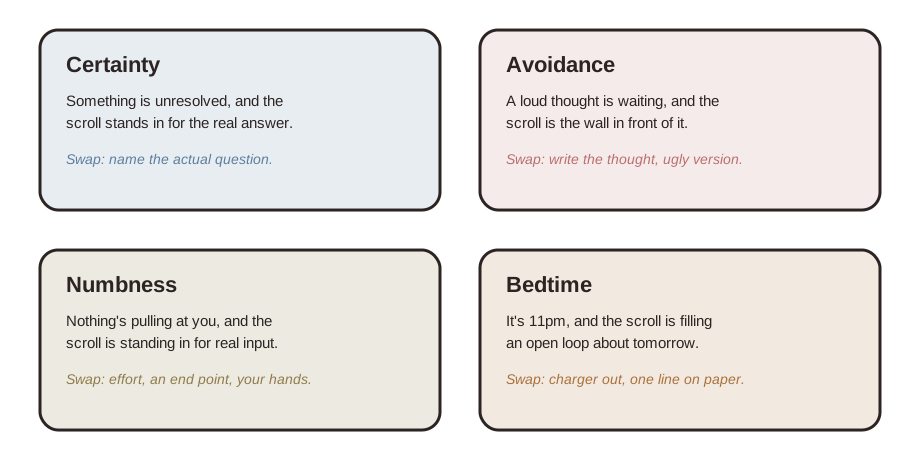
Not sure which of the four you're running? The two-minute scroll-type quiz sorts it — eight questions, no email, and it hands you the matching swap.
If you're scrolling to feel certain
Scrolling to feel certain is the most common pattern of the four. There's an open question in your life — a result you're waiting on, money, someone who hasn't replied, something at work — and the scroll is a substitute for the real answer.
Write down the actual question. One sentence, plainly. Not "the world is a mess" but "will I be able to make rent in November." Not "everything's weird with him" but "does he still want this." Half the time, writing it is enough, because you immediately see the feed was never going to answer it.
Then do the smallest real thing that touches it. Check the balance. Look up the actual policy instead of the take about the policy. Send the message you've been drafting in your head for two days. Ten minutes of a real answer beats an hour of adjacent ones, even when the real answer is worse.
If there's nothing to do, schedule the checking. Not "stop checking" — that never holds. Pick a time. Nine tomorrow morning, once. Uncertainty is far more tolerable when it has an end time attached, even an arbitrary one.
If you're scrolling to avoid a thought
Different shape entirely. Nothing is unresolved out in the world; something is loud in your head, and the scroll is a wall between you and it. You'll recognise this one by the feeling when you finally stop — the thought is right there, waiting, exactly where you left it.
Type the thought out, in its ugly version. Not a journal entry. One sentence, the way it actually sounds in your head, with the harsh phrasing intact. "I ruined it." "Everyone can tell." Cleaning it up first defeats the point — you'd be avoiding it again, just with better handwriting.
Then get more than one reading of it. This is the part people skip. A single counter-thought feels like an argument you're losing to yourself. Three different angles on the same sentence — a more accurate one, a what-do-I-actually-do-next one, and one that's simply less cruel — gives you somewhere to land instead of something to debate.
Or say it out loud. A voice note to a friend counts. Thoughts lose a surprising amount of power in the gap between being thought and being said, mostly because saying them forces them into a complete sentence, and a lot of them turn out not to survive that.
It's also worth noticing what your self-talk does under pressure — the tone it takes when a thought like this shows up is usually a pattern you can recognise once you see it named.
If you're scrolling because you've gone numb
You're not anxious in this pattern, you're flat — nothing is pulling at you, and you just can't get up. The scroll here isn't a wall, it's a substitute for input, and it's the only pattern where the classic advice actually works, though it needs weight to it, not pleasantness.
Something with physical effort. Stairs, twenty press-ups, carrying the laundry, a walk with no headphones. The absence of audio matters more than the walk does.
Something with a visible end. One drawer. The dishes. Making the bed at 10pm. A task with a defined finish gives you the completion signal the feed keeps promising and never delivers.
Something that needs your hands. Cooking anything that requires chopping. An instrument. This works because the phone physically cannot be held at the same time, which is a stupid mechanism that is nevertheless the most reliable one on this list.
If it's 11pm and you're in bed
Most doomscrolling actually happens here, in bed at night, and the fix is embarrassingly logistical rather than psychological — mostly a matter of a room that has nothing else in it worth looking at.
Move the charger. Out of the bedroom. Not as a moral commitment — as a piece of furniture arrangement. The single highest-return change most people make.
Put something on you've already heard. An audiobook or podcast you know the ending of. Novelty is what keeps you awake; familiarity gives your attention somewhere to go without giving it anything to chase.
Write tomorrow's first task on paper. One line. A large amount of late-night scrolling is an open loop about the next day that hasn't been given anywhere to sit.
The 90-second version, for when you're already in it
You won't remember any of the above mid-scroll, so here's one thing, short enough to actually recall: notice you're scrolling, then ask yourself "what am I hoping to find?"
Then answer honestly. It'll be one of: an answer, a distraction, or nothing. If it's an answer, go get the real one. If it's a distraction, name what you're distracting yourself from. If it's nothing — and it often is — you'll usually find your thumb has already stopped.
That question isn't a trick and it isn't a mindfulness exercise. It just makes an automatic behaviour briefly deliberate, and most of doomscrolling's power comes from being automatic. Susan Albers, PsyD, a psychologist at Cleveland Clinic, describes exactly this mechanism: "It can become a mindless habit. A lot of times, you might not even be aware you're doing it. But once you have a spare moment, you pick up your phone and start scrolling. It becomes second nature."[4]
What doesn't work, so you can stop trying
Four things fail for related reasons, and it's worth knowing why before you spend more effort on them: they all treat the surface behaviour as the problem instead of the function it's serving.
Curating a nicer feed. Tested, and the benefit is short-lived at best. The behaviour isn't about the content.
Screen time limits alone. They create a five-second obstacle and a small amount of shame. They don't touch the reason.
Deleting the app in a moment of resolve. You'll reinstall it. Everyone does. It isn't a character flaw, it's that the reason survived the deletion.
Being harder on yourself about it. Doomscrolling is strongly linked with distress, and most of the evidence is cross-sectional — meaning feeling worse likely drives more scrolling about as much as scrolling drives feeling worse[1]. Adding self-criticism to the pile is not a neutral move.
Where this fits
MindLift was built for the second pattern above — scrolling to keep a thought at arm's length. You type the thought exactly as it arrives, and you get three reframes back in about a minute: one realistic, one focused on the next actual step, one that's kinder without being false.
Each one is tagged with the thinking pattern behind it, so you start recognising the shape of your own loop rather than just the feeling of it.
It's not a feed, there's no streak to keep, and it isn't something to talk to at night. It's for the ninety seconds between noticing you're avoiding a thought and doing something with it.
The rest of the list above doesn't need an app. Most of it needs a charger in a different room. If you want the reframe part running in the background, MindLift is free to start. And if you still don't know which of the four you are, the scroll-type quiz takes two minutes.
If you're in acute distress or having thoughts of harming yourself, please contact a local crisis line or emergency services. MindLift is a self-help tool for everyday negative thinking and isn't a substitute for professional support.
Frequently asked questions
Why do I doomscroll even when it makes me feel worse?
Because the feed offers something that feels like resolution. Research on doomscrolling points to intolerance of uncertainty as a core driver — when something is unresolved, scrolling functions as a search for an answer. Each post carries an implicit promise that the next one will settle things, and that near-miss is what keeps the behaviour going even as your mood drops.
How long does it take to stop doomscrolling?
There's no fixed timeline, and framing it as a habit to break is often unhelpful. It's more reliable to treat each episode individually: notice it, identify which function it's serving, and swap in something that serves the same function. The frequency tends to drop as the underlying reasons get addressed rather than as willpower accumulates.
Are screen time apps useful for doomscrolling?
They're mildly useful as friction and useless as a solution. They remove the tool without touching the reason you reached for it, which is why most people override the limit within a week. They work better alongside something that addresses the driver than as a standalone fix.
What should I do instead of scrolling at night specifically?
Move your charger out of the bedroom, put on audio you've already heard, and write tomorrow's first task on paper. Night scrolling is usually an open loop about the next day plus a room that has nothing else in it to look at. Both are logistics problems more than psychology problems.
Is doomscrolling actually bad for you or is that overstated?
A 2026 systematic review found consistent associations with depression, anxiety, psychological distress and sleep disturbance, with moderate effect sizes across studies. The researchers noted that most evidence remains cross-sectional, so the direction of causality isn't fully established — distress likely drives scrolling as much as the reverse. The relationship is real; the "phones are destroying your brain" version of it is not what the evidence says.
Like what you're reading?
Take control of your mental wellness
Reframe the thought that started it — personalized CBT reframes in the MindLift app.


Free to start · no account required
- Iqbal, S., & Iqbal, S. (2026). Doomscrolling and Mental Health Outcomes Among Young Adults: A Systematic Review. Research Square (preprint). — DOI (opens in a new tab)
- Avcı, G., Vampa, M., Kreso, I., Homaei, M., & Putra, O. P. (2026). Emerging evidence on doomscrolling: A scoping review of empirical studies. Journal of Social Media Research, 3(2), 162–171. — DOI (opens in a new tab)
- Buchanan, K., Aknin, L. B., Lotun, S., & Sandstrom, G. M. (2021). Brief exposure to social media during the COVID-19 pandemic: Doom-scrolling has negative emotional consequences, but kindness-scrolling does not. PLOS ONE, 16(10). — DOI (opens in a new tab)
- Albers, S. (2026). Caught in a Doomscrolling Loop? Here's How To Break Free. Cleveland Clinic Health Essentials. — View source (opens in a new tab)
CBT & Self-Talk Researchers
MindLift content is grounded in cognitive behavioral therapy principles and designed to help you shift harsh self-talk in real time. Our guides focus on practical, evidence-based techniques you can use in the moment.
Was this article helpful?