
Turn this into a daily habit — free to start in the MindLift app:
Picture Sam. At 6:12 p.m., she sends a message to her friends’ group chat: a photo of a terrible cake she baked. It looks like it melted and then gave up on life. Underneath she writes: “Bakery opening soon, taking orders 😂”
She puts her phone down, feeling pleased with herself.
At 6:40, nobody has replied.
At 7:15, still nothing. Two people have seen it. Nobody has laughed.
By 8:00, Sam’s brain has written a whole story. They think it’s cringe. I’m always trying too hard. They probably have a separate chat without me. They’ve been drifting away for months and I’ve just been too dumb to notice.
One unanswered photo of a sad cake has turned into the end of a friendship.
If this feels familiar, you already know the frustrating part: you can’t stop thoughts like these from showing up. Telling yourself “stop thinking about it” almost never works.
But here’s what psychology has learned. You don’t control which thoughts arrive. You have a lot more say in what you say back to them.
Sam is a composite, not a real user. Her evening is the kind many overthinkers will recognize. That evening, she tried six sentences. Each one is grounded in research, and each one does a different job.
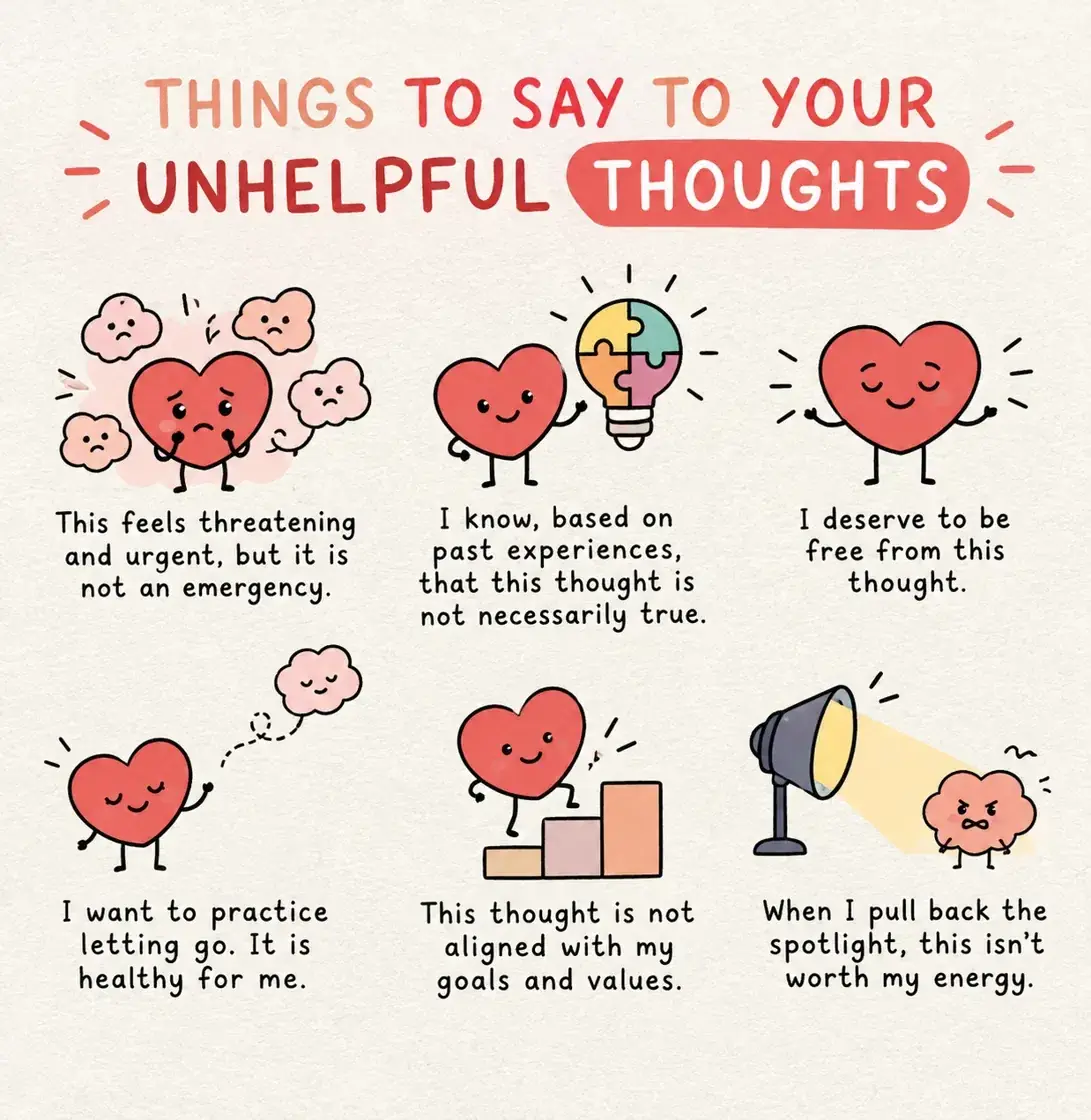
The six lines at a glance
- “This feels threatening and urgent, but it is not an emergency.” Separates the alarm from the actual situation.
- “I know, based on past experiences, that this thought is not necessarily true.” Turns a verdict back into a guess.
- “I deserve to be free from this thought.” Stops you beating yourself up for having it.
- “I want to practice letting go. It is healthy for me.” Replaces the fight with a gentler kind of attention.
- “This thought is not aligned with my goals and values.” Asks whether the thought is useful, not just whether it’s true.
- “When I pull back the spotlight, this isn’t worth my energy.” Puts the situation back at its real size.
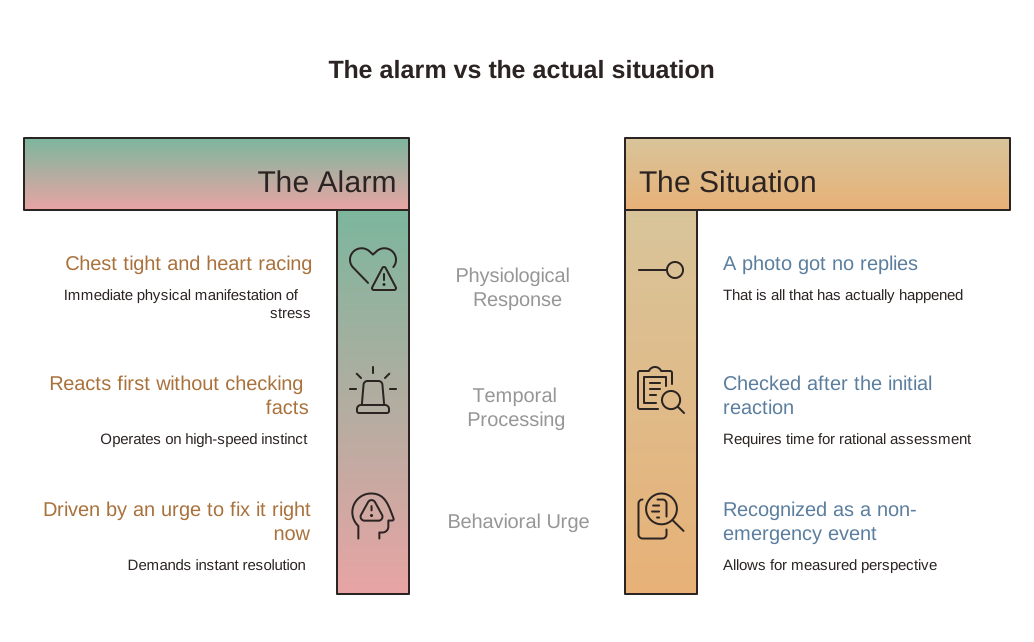
1. “This feels threatening and urgent, but it is not an emergency.”
At 8:03, Sam’s heart is going fast. Her chest feels tight. She has a strong urge to do something: delete the message, send “lol never mind,” or check the chat for the fortieth time.
That urgency isn’t a personality flaw. It’s biology. Your brain’s threat system, which includes a small region called the amygdala, is built to react fast and check the facts later. For our ancestors, being pushed out of the group was a real danger, so the brain learned to treat social rejection seriously. Early brain-imaging research by Naomi Eisenberger and colleagues even suggested that being left out activates some of the same brain systems involved in physical pain[1]. Later research has debated how close that overlap really is, but the feeling is real either way.
So when the chat goes quiet, your body can react as if something is genuinely wrong.
“This feels threatening and urgent, but it is not an emergency” works because it doesn’t argue with the feeling. It acknowledges the alarm (“this feels threatening”) and then gives the thinking part of your brain the final word (“but it is not an emergency”).
Sam says it once, quietly, out loud. Then she puts the phone face-down. The urge to fix it right now drops from a ten to about a six.
What this line does: it separates the alarm from the actual situation.
2. “I know, based on past experiences, that this thought is not necessarily true.”
At 8:20, the thought comes back with new evidence: Nobody replied because they’re annoyed with you.
So Sam does what CBT therapists call checking the evidence. She asks: Has this happened before? What actually happened then?
She remembers last month, when the chat went silent for an entire day. She was sure everyone was upset with her. It turned out two friends were at a wedding, one had lost her phone, and one simply forgot to reply.
She remembers that she leaves messages on “seen” all the time. She does it when she’s cooking, when she’s tired, or when she plans to reply later and then forgets. It has never once meant she disliked anyone.
This is the core of cognitive behavioral therapy: treating thoughts as guesses to test, not facts to obey. The assumption that silence means annoyance has a name, too: mind reading. The phrase “not necessarily true” matters here. Sam doesn’t have to prove the thought is false. She just has to notice that it’s not the only explanation, and probably not the most likely one.
What this line does: it turns a verdict back into a hypothesis.
3. “I deserve to be free from this thought.”
At 8:45, Sam notices something else happening. On top of the worry, she’s starting to criticize herself for worrying. Why are you like this? It’s a cake photo. Normal people don’t spiral over a cake photo.
This is sometimes called the second arrow. The first arrow is the painful thought. The second arrow is beating yourself up for having it.
“I deserve to be free from this thought” is a line of self-compassion. Psychologist Kristin Neff, who pioneered research on it, describes self-compassion as treating yourself the way you’d treat a good friend who’s struggling[2]. A meta-analysis of the studies that followed found self-compassion linked with lower anxiety and less depression and stress[3].
If a friend told Sam, “I’m spiraling because nobody replied to my message,” Sam would never say “you’re being ridiculous.” She’d say, “Oh, that’s such a horrible feeling. You don’t deserve to sit in that all night.”
So she says it to herself instead. If that’s the part you find hardest, try these self-compassion exercises for a harsh inner critic, or see 40 negative self-talk examples with CBT reframes for more examples of kinder self-talk.
What this line does: it removes the second arrow.
4. “I want to practice letting go. It is healthy for me.”
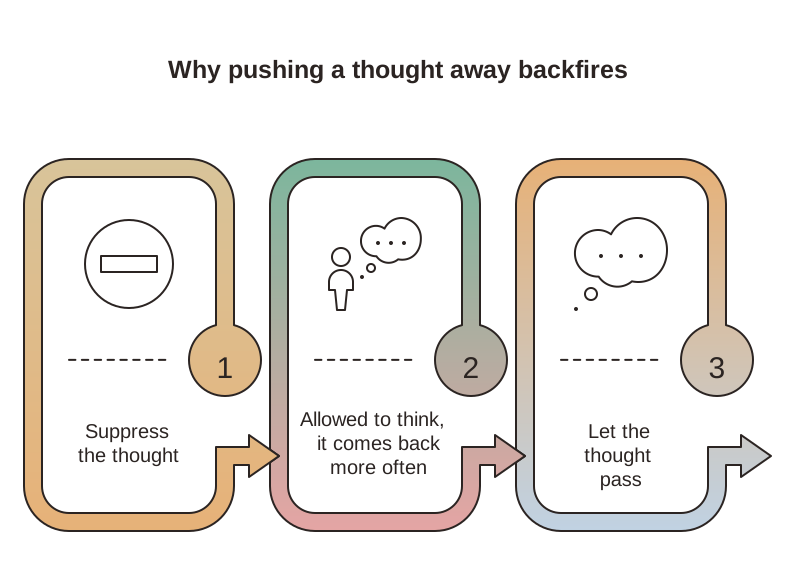
Now Sam makes the classic mistake. She tries to push the thought away. Don’t think about the chat. Don’t think about the chat. Don’t think about—
She thinks about the chat.
In 1987, psychologist Daniel Wegner and colleagues ran a famous experiment. They asked people not to think about a white bear for five minutes, and to ring a bell every time they did. The bell kept ringing. Then, when the same people were told they could think about the bear, it came up even more often than for people who had been allowed to think about it from the start[4]. Trying to suppress a thought tends to make it bounce back. (More on why in why thought-stopping techniques backfire.)
That’s why this line says letting go, not pushing away. In Acceptance and Commitment Therapy (ACT), this skill is called cognitive defusion: stepping back and watching a thought instead of wrestling with it[5]. One popular ACT exercise asks you to imagine placing each thought on a leaf floating down a stream. You don’t throw it, and you don’t grab it. You just watch it drift.
Sam imagines the thought “they’re annoyed with me” as a little cloud, floating slowly out of the room.
It comes back twice. Each time, she lets it drift again. That’s the “practice” part. Letting go isn’t a one-time event. It’s a skill that gets easier with repetition. (For a longer look at defusion, read not every thought deserves a response.)
What this line does: it replaces the fight with a gentler kind of attention.
5. “This thought is not aligned with my goals and values.”
At 9:10, the anxious thought offers Sam a plan: Leave the group. Stop sending stuff. If you don’t try, you can’t be rejected.
This is where the thought gets sneaky. It isn’t just making Sam feel bad. It’s trying to steer what she does next.
ACT has a powerful question for moments like this: Is this thought helping me move toward the person I want to be, or away from it?
Sam thinks about what she actually values. Friendship. Being funny. Being the person who sends the ridiculous cake photo. Leaving the chat wouldn’t protect any of that. It would quietly give it all away.
So instead of deciding whether the thought is true, she asks whether it is useful. It isn’t. Then she does something small that matches her values. She texts her closest friend, Ellie, directly: “How was your day? 💛”
What this line does: it shifts the question from “Is this true?” to “Is this taking me where I want to go?”
6. “When I pull back the spotlight, this isn’t worth my energy.”
At 9:30, Sam has one last thought: Everyone saw that message and thought it was embarrassing.
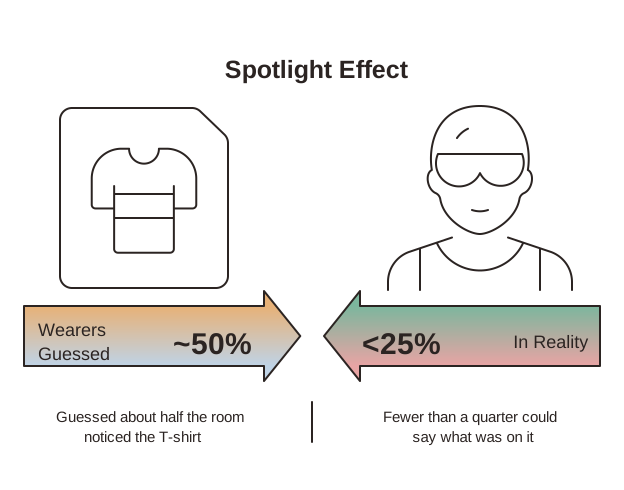
In 2000, psychologists Thomas Gilovich, Victoria Medvec and Kenneth Savitsky studied a bias called the spotlight effect[6]. They had students walk into a room wearing an embarrassing T-shirt. The wearers guessed that about half the room had noticed it. In reality, fewer than a quarter could say what was on the shirt.
We consistently overestimate how much other people notice us, because we’re the main character in our own heads. Everyone else is busy being the main character in theirs. (The same bias shows up when you replay conversations and decide you’re bad at socializing.)
When Sam pulls back the spotlight, the picture changes. Her friends are probably making dinner, watching something, or sitting on a bus. Her cake photo is one message among dozens on their phones that evening. It’s a big deal in her head, not in theirs.
So she asks a final question: is this worth the rest of my evening? It isn’t. She makes tea and starts the episode she’s been saving.
What this line does: it puts the situation back at its real size.
10:47 p.m.
Sam’s phone buzzes.
Ellie: “OMG SORRY, was at the cinema!! Day was good!! Also is the bakery real, I need that cake in my life 😭”
Then the group chat wakes up all at once. Three laughing emojis. A voice message of someone wheezing with laughter. A photo of an even worse cake from three years ago.
Nobody had been annoyed. They had just been living their evenings.
Here’s the important part, though: the six lines worked before the reply came. Sam didn’t feel better because her friends answered. She felt better because she stopped letting a guess run her entire night. The reply was a bonus.
That’s the real goal. Thoughts like “they’re annoyed with me” will show up again. The point isn’t to need reassurance every time. It’s to have something to say back. If unanswered messages are your most common trigger, read more about texting anxiety and the reply spiral.
How MindLift helps you find your lines in the moment
These six sentences are easy to read in a blog post. They’re much harder to remember at 8:03 p.m. with your heart racing and your phone in your hand.
That’s the moment MindLift is built for. When a thought like “everyone’s annoyed with me” shows up, you write it down exactly as it sounds in your head. MindLift names the pattern behind it, often mind reading or catastrophizing, and gives you a more accurate way to see it, in about 60 seconds. Reframes come in three tones (Realist, Growth and Compassionate), so you can pick the reply you actually believe, like Sam’s six lines.
Save the reframes and affirmations that land to your Favorites, so the right sentence is ready the next time the same thought returns. Your “This week’s reframes” card shows your top pattern, and many people find their thoughts follow a predictable script. A script you can predict is one you can answer faster.
Want to know more about the method? Read how to reframe a negative thought, step by step. Want the full list of thinking patterns? See the cognitive distortions glossary.
Save your six lines
You don’t need all six every time. Most people have one or two that land hardest. Pick the line that feels most like something you would say, and keep it somewhere you’ll see it.
Or keep it in MindLift, where it’ll be ready the next time the chat goes quiet.
Download MindLift and find your reply to the next anxious thought. Free to start, on iOS 15+, Android 8+ and the web.
Download MindLift for iOS and Android
Thoughts will always show up uninvited. You get to decide how the conversation goes.
Sam and Ellie are illustrative characters, not real users. This article is for general education and isn’t a diagnosis or treatment. If anxious thoughts feel overwhelming or affect your daily life, consider talking to a licensed mental health professional. MindLift is a self-help tool and not a substitute for professional care.
Frequently asked questions
Can you stop negative thoughts from happening?
Not reliably. Research on thought suppression shows that trying to force a thought away often makes it come back more. A more effective approach is changing how you respond to the thought: noticing it, questioning it, or letting it pass.
What is cognitive defusion?
Cognitive defusion is a skill from Acceptance and Commitment Therapy (ACT). It means stepping back and seeing a thought as just a thought, instead of a fact or a command. Imagining thoughts as leaves on a stream or clouds drifting by are common defusion exercises.
Why does an unanswered message feel so bad?
Humans are wired to treat social belonging as important, so the brain’s threat system can react strongly to possible rejection. Combined with the spotlight effect (overestimating how much others notice us), a quiet chat can feel much bigger than it is.
Is this the same as positive thinking?
No. None of these lines pretend everything is great. They acknowledge the feeling, check the evidence, and refocus on what matters. That makes them more believable than forced positivity.
What if the thought is actually true?
Sometimes it might be. Even when a thought contains some truth, you can ask whether dwelling on it helps you act in line with your values. If something really is wrong in a friendship, a kind, direct conversation helps more than an evening of spiraling.
Can MindLift help with anxious thoughts?
MindLift is a self-help app that helps you practice catching and responding to unhelpful thoughts using techniques from CBT. It isn’t a replacement for therapy. If anxious thoughts feel overwhelming or affect your daily life, please reach out to a mental health professional.
Like what you're reading?
Continue your wellness journey
Reframe negative thoughts in 60 seconds — free to start in the MindLift app.


Free to start · premium optional