
Turn this into a daily habit — free to start in the MindLift app:
Understanding Anxiety
Anxiety
A natural emotional response to perceived threats that becomes problematic when it's persistent, excessive, and interferes with daily life. While fear responds to immediate danger, anxiety anticipates future threats—often ones that never materialize.
Your brain cannot distinguish between real and imagined threats. When you worry about a presentation next week, your body responds as if you are being chased by a predator right now. This is why anxiety feels so physically overwhelming.
adults in the US experience anxiety disorders each year—yet only 37% receive treatment
Source: Anxiety and Depression Association of America, 2024
"Anxiety does not empty tomorrow of its sorrows, but only empties today of its strength. The goal is not to eliminate anxiety, but to develop the skills to manage it effectively."
Charles Spurgeon, adapted for modern psychology
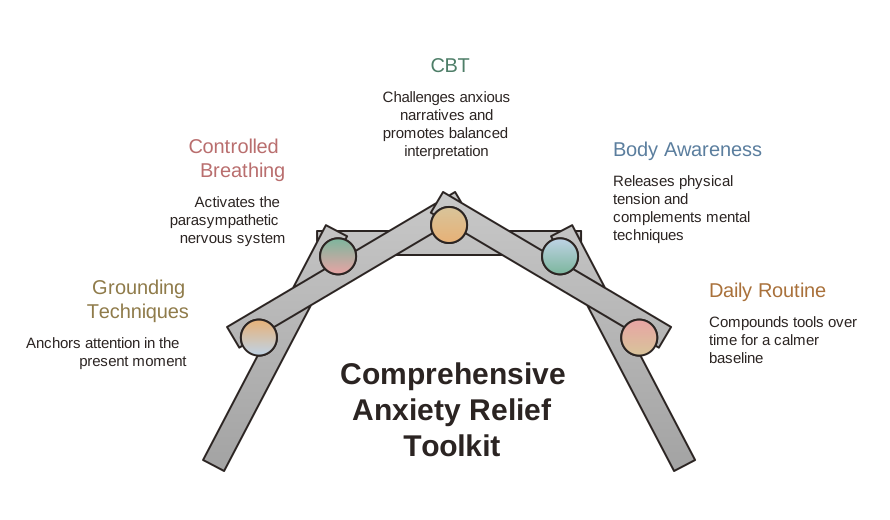
5 Anxiety Relief Techniques You Can Use Anywhere
1. The 5-4-3-2-1 Grounding Technique
This sensory awareness exercise interrupts anxiety by forcing your brain to focus on the present moment instead of catastrophizing about the future.
- 5 things you see: Look around and name them (blue pen, coffee mug, window)
- 4 things you can touch: Notice textures (soft sweater, cool desk, smooth phone)
- 3 things you hear: Even subtle sounds (distant traffic, AC humming, breathing)
- 2 things you smell: Coffee, lotion, fresh air, even neutral scents count
- 1 thing you taste: Your last meal, gum, or just notice your mouth
✓ Works in 2-3 minutes • ✓ No tools required • ✓ Helps with acute anxiety in the moment
2. Box Breathing (4-4-4-4)
Used by Navy SEALs to stay calm under pressure, box breathing activates your parasympathetic nervous system—your body's natural relaxation response.
- Breathe in slowly through your nose for 4 seconds
- Hold your breath for 4 seconds
- Exhale slowly through your mouth for 4 seconds
- Hold empty lungs for 4 seconds
- Repeat 4 times (about 1 minute total)
✓ Reduces heart rate in about a minute • ✓ Lowers cortisol • ✓ Safe during panic attacks
3. CBT Thought Challenging
Cognitive Behavioral Therapy teaches you to identify distorted thinking patterns and replace them with realistic alternatives.
Anxious thought:
If I mess up this presentation, I will get fired and lose everything.
Balanced alternative:
One imperfect presentation does not define my career. I have succeeded before and learned from mistakes. Even if it goes poorly, the likely consequence is constructive feedback, not termination.
✓ Prevents anxiety spirals • ✓ Builds long-term resilience • ✓ Most effective anxiety treatment
4. Progressive Muscle Relaxation
Systematically tense and release muscle groups to release physical anxiety stored in your body.
Start with your toes: tense for 5 seconds, release for 10. Move up through calves, thighs, abdomen, chest, arms, and face. The contrast between tension and relaxation teaches your body what calm feels like.
5. Personalized Affirmations
Generic affirmations fail because they do not address your specific anxiety. MindLift AI creates affirmations tailored to your triggers—making them land where generic ones don't.
Instead of I am calm (too vague), try: I have handled difficult conversations before and I can handle this one. My worth is not determined by one interaction. This specificity activates different neural pathways than generic positivity.
MindLift vs Traditional Anxiety Methods
Feature Comparison
| Feature | MindLift | Traditional Methods |
|---|---|---|
| Instant Relief Techniques | ||
| Personalized to Your Anxiety | ||
| CBT-Based Strategies | Some | |
| Works Offline | ||
| Cost | Free to start | $10-30/month |
| Panic Attack Support |
✓ = Available feature • ✗ = Not available • Data updated October 2025
Start Reducing Your Anxiety Today
- Download MindLift and take the anxiety assessment to identify your primary triggers
- Practice box breathing for 1 minute every morning to build your relaxation reflex
- Save the 5-4-3-2-1 technique to your phone notes for emergency panic relief
- Use CBT thought challenging whenever you catch yourself catastrophizing
- Read your personalized affirmations from MindLift during high-anxiety moments
Consistency is what compounds: MindLift users who practice these techniques daily tend to notice real, lasting improvement in how they handle anxiety within weeks, not months.
Find your pattern in 2 minutes
- How Strong Is Your Social Anxiety Loop?A 2-minute science-based quiz to understand your overthinking patterns in social situations. Discover if your brain runs a light, active, strong, or intense anxiety loop.
- Which Thought Distortion Runs Your Brain?Everyone has a default. Eleven quick moments name yours — catastrophizing, mind reading, should statements and eight more — plus the co-pilot that rides along.
Frequently asked questions
What's the fastest way to stop a panic attack?
The 5-4-3-2-1 grounding technique and box breathing (4-4-4-4) provide the fastest relief—usually within 2-3 minutes. Focus on naming 5 things you see, 4 you touch, 3 you hear, 2 you smell, 1 you taste. This interrupts the panic cycle by anchoring you in the present moment instead of catastrophic thoughts.
Can anxiety be cured or just managed?
Anxiety is a natural human emotion that can't be 'cured'—nor should it be, as some anxiety is protective. However, anxiety disorders can be effectively treated to the point where symptoms no longer interfere with daily life. CBT provides lasting skills that help most people manage anxiety significantly better.
Why do breathing exercises help with anxiety?
Slow, controlled breathing activates your parasympathetic nervous system (your body's 'calm down' response), lowering heart rate and cortisol levels. During anxiety, you typically breathe rapidly and shallowly, which signals danger to your brain. Box breathing reverses this signal, telling your brain you're safe.
Are anxiety apps as effective as therapy?
For mild to moderate anxiety, CBT-based apps like MindLift can be highly effective, offering many of the same core techniques used in therapist-led CBT. They provide 24/7 access to evidence-based techniques at a fraction of therapy costs. Severe anxiety, trauma, or suicidal thoughts still require professional therapy.
Like what you're reading?
Continue your wellness journey
Reframe negative thoughts in 60 seconds — free to start in the MindLift app.


Free to start · no account required
- Bandelow, B., Michaelis, S., & Wedekind, D. (2017). Treatment of anxiety disorders. Dialogues in Clinical Neuroscience, 19(2), 93–107. — DOI (opens in a new tab)
- Ma, X., Yue, Z. Q., Gong, Z. Q., Zhang, H., Duan, N. Y., Shi, Y. T., Wei, G. X., & Li, Y. F. (2017). The Effect of Diaphragmatic Breathing on Attention, Negative Affect and Stress in Healthy Adults. Frontiers in Psychology, 8, 874. — DOI (opens in a new tab)
- Craske, M. G., Stein, M. B., Eley, T. C., Milad, M. R., Holmes, A., Rapee, R. M., & Wittchen, H. U. (2017). Anxiety disorders. Nature Reviews Disease Primers, 3, 17024. — DOI (opens in a new tab)
CBT & Self-Talk Researchers
MindLift content is grounded in cognitive behavioral therapy principles and designed to help you shift harsh self-talk in real time. Our guides focus on practical, evidence-based techniques you can use in the moment.
Was this article helpful?