
Turn this into a daily habit — free to start in the MindLift app:
You replay the conversation for two hours after it ends. You mentally rehearse what you'll say before making a phone call. You cancel plans — not because you don't want to go, but because the version of you that exists in your head at 7pm on a Friday is apparently incapable of normal human interaction.
Social anxiety isn't shyness. It's not introversion. It's your brain running a very specific, very exhausting threat-detection program every time another person is involved.
The good news: threat-detection programs can be updated. Here's what actually works.
What social anxiety actually is (it's not about people)
Social anxiety isn't really about other people. It's about what you think other people are thinking about you — which is almost entirely constructed by your own brain, not by actual data.
Your brain builds a model of how others see you, treats that model as fact, and then generates a full threat response around it. The awkward pause. The thing you said five years ago. The look on their face when you walked in. None of it is data. All of it feels real.
Cognitive models of social anxiety describe this as building a mental picture of how you appear to others — and believing you're being watched, evaluated, and judged far more than you actually are. Research shows people tend to overestimate how much others notice their appearance and mistakes, and socially anxious people tend to judge their own performance more harshly than observers do. Translation: you are not as visible as you think you are.
Is social anxiety the same as being shy?
No. Shyness is a temperament trait — mild discomfort in new social situations that usually fades quickly. Social anxiety is a cognitive pattern: the brain runs a threat-detection program around social evaluation before, during, and after interactions, generating a full stress response. It's a thinking loop, not a personality type.
Stop trying to "feel less anxious" before social situations
Most advice tells you to calm down before social events. Deep breaths. Visualize success. Fake confidence until you have it.
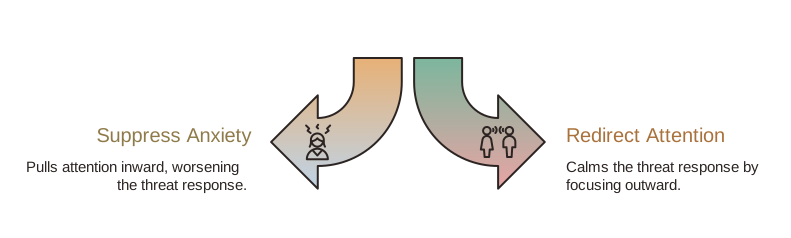
The problem: trying to suppress anxiety in real time actually increases it. When you focus on managing how anxious you appear, you divert cognitive resources away from the conversation — which makes you more self-monitoring, more stilted, and more convinced that something is going wrong.
The goal isn't to feel less anxious going in. The goal is to redirect your attention outward — to the other person, the conversation, the moment — instead of inward, to the running commentary about how you're coming across. This is harder than it sounds, but it's the actual mechanism that works.
Catch the thought before the situation
Social anxiety has a pre-game. The spiral usually starts before you even get there.
What if I don't know anyone? What if I say something weird? What if they think I'm boring?
These are predictions, not facts. And they're almost always worst-case. The CBT move is to catch them early — before they've had time to build a convincing case — and run a quick reality check.
Ask: What's the actual evidence for this? What's more likely? What would I tell a friend who thought this?
Sixty seconds of reframing before an anxiety-triggering event can change the entire experience of it. This is where MindLift helps — type out the specific thought your brain is running before the event, and get a reframe based on your exact words. Not generic reassurance. Your actual thought, examined.
Gradual exposure — done right
Exposure therapy works. But "just put yourself out there" is not exposure therapy — it's suffering without a plan.
Real exposure is structured: start with situations that feel mildly uncomfortable, not terrifying. Stay long enough to let anxiety peak and come back down on its own — this is the part most people skip. Repeat until that situation stops triggering a full threat response.
The goal isn't to prove the feared outcome won't happen. It's to teach your nervous system that it can handle discomfort — and survive it without catastrophe. The anxiety doesn't have to go away for the situation to get easier. You just have to stay long enough to find out.
Start smaller than you think you need to. One coffee with one person. One comment in one meeting. Progress compounds.
Stop the post-event autopsy
The conversation is over. Everyone has moved on.
Except you, who are currently replaying every moment in high definition, identifying every possible thing you could have said better, building a case for why you made a terrible impression.
This post-event processing is one of the most damaging patterns in social anxiety — not because the events were actually bad, but because the review cements the belief that they were. You're editing your own memory to confirm what you feared.
The interrupt: notice when the replay starts, label it ("this is post-event processing, not reality"), and deliberately redirect. You don't have to argue with the thoughts. Just stop feeding them.
Knowing what's for what: therapy, medication, apps
Therapy (CBT specifically) is the gold standard for social anxiety. If it's significantly affecting your life, career, or relationships, find a therapist who specializes in it. The evidence base is strong.
Medication (typically SSRIs or beta-blockers for acute situations) can reduce the physiological intensity enough to make the cognitive work possible. Worth discussing with a doctor if anxiety is severe.
Tools like MindLift fill the gap in between — the 167 hours a week that aren't therapy. Real-time thought interruption when you're spiraling before an event, after one, or replaying something from three years ago at 11pm.
None of these are either/or. They work better together.
Social anxiety convinces you that the problem is other people, or situations, or something fixed about who you are. It's not. It's a set of thinking patterns — learned, practiced, and deeply grooved — that your brain runs automatically. And what's automatic can be interrupted. What's grooved can be regrooved. It takes time and repetition. And it helps to have something in your pocket for when the spiral starts.
For more on the CBT mechanics: How to Reframe Social Anxiety with CBT →
Frequently asked questions
What's the difference between shyness and social anxiety?
Shyness is a temperament trait — some discomfort in new social situations that usually fades once you're comfortable. Social anxiety is a cognitive pattern: the brain constructs a detailed threat model around social evaluation, runs it before, during, and after social interactions, and generates a full stress response around it. Shyness is a personality feature. Social anxiety is a thinking loop.
Can you really retrain social anxiety without a therapist?
Yes, for mild-to-moderate social anxiety. CBT-based self-help tools, structured exposure practice, and real-time thought reframing can measurably reduce symptoms. For social anxiety that significantly impacts your career, relationships, or daily functioning, a therapist who specializes in CBT or exposure therapy is the most effective intervention. Apps like MindLift work well as between-session tools in either case.
Why does post-event processing make social anxiety worse?
Post-event processing — replaying the conversation, editing your performance, building a case for how badly it went — reinforces the belief that the situation was threatening. You're not reviewing what happened; you're constructing a version of events filtered through the lens of your anxiety. Research suggests that socially anxious people tend to overestimate how negative others' impressions of them are.
How long does it take to see results from CBT for social anxiety?
Structured CBT for social anxiety is usually delivered as a course of weekly sessions, and trials show it helps many people. How long change takes varies from person to person — with consistent reframing work, change in specific situations builds gradually. The mechanism is neuroplasticity: the more you practice interrupting the threat loop, the more automatic the interruption becomes.
How does exposure therapy work for social anxiety?
Structured exposure works by having you stay in an anxiety-provoking situation long enough for the anxiety to peak and naturally decrease. This teaches the nervous system that discomfort doesn't mean danger and that you can survive it. The key is structure: starting with mildly uncomfortable situations, not jumping to the most terrifying, and staying long enough for the anxiety to come down on its own.
Like what you're reading?
Continue your wellness journey
Reframe negative thoughts in 60 seconds — free to start in the MindLift app.


Free to start · premium optional