
Turn this into a daily habit — free to start in the MindLift app:
"You always do this. Why can't you just get it together?"
Sound familiar? That voice in your head — the one that narrates your failures in real time — isn't just annoying. Neuroscience now shows it's actively rewiring your brain, flooding your body with stress hormones, and making anxiety your new default setting. The good news: the same science that explains how self-talk hurts you also shows exactly how to reverse it — and it takes less time than you think.
Most of the thoughts your brain generates every day, you never consciously choose. For a lot of people, that running commentary skews negative and repeats itself — the same worries, on a loop, day after day. These thoughts fire automatically — shaped by past experiences, stress levels, and the neural pathways your brain has spent years reinforcing. The problem isn't that you think negatively sometimes. The problem is that without intervention, your brain gets better and better at it.
Why do we feel trapped by our own thoughts?
Anxiety is a natural part of life. But when your inner dialogue becomes a constant loop of criticism, catastrophe, and self-doubt, it stops being useful and starts being harmful. Understanding what triggers negative self-talk — and what it does to your brain — is the first step toward changing it.
Your body hears every word
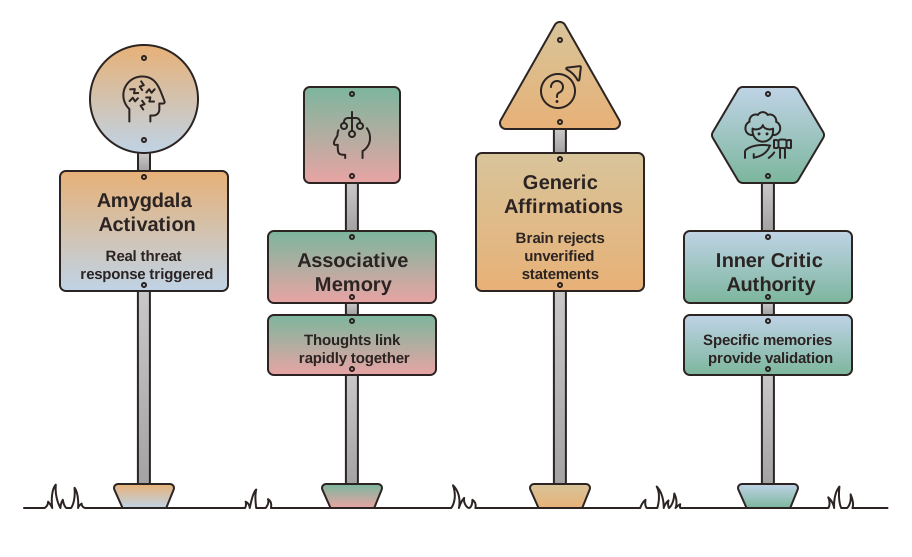
When you think "I'm such an idiot," your amygdala — the brain's threat detection centre — fires as if a real danger just appeared. Cortisol floods your system. Heart rate rises. Muscles tense. Your body enters a low-grade stress state, even though nothing in your environment has changed. The thought itself became the stressor. This is why negative self-talk leaves you feeling physically exhausted — you've been running your stress response on a loop all day.
Spirals happen faster than you think
One anxious thought leads to another within seconds. "I made a mistake" becomes "I always do this" becomes "everyone thinks I'm incompetent" before you've even finished your coffee. This is rumination — and once it gains momentum, the emotional hijack makes rational thinking much harder.
You believe it because it sounds like you
Generic affirmations ("I am worthy! I am enough!") fail because your brain rejects statements it can't verify. But your inner critic speaks in your own voice, with your own memories and specific failures as evidence. That's why self-referential negative thoughts feel so true — and why simply "thinking positive" rarely works. The solution isn't to silence the voice. It's to challenge it with something equally personal, equally specific, and more accurate.
Overthinking trains your brain for more overthinking
Every time you replay a painful thought, you strengthen the neural pathway that leads to it. Neuroplasticity works in both directions — the brain becomes more efficient at whatever you repeat. Unchecked rumination is literally practice for anxiety. The more you do it, the easier it gets, and the harder it becomes to break the pattern without deliberate intervention.
Four techniques to stop the spiral — before it starts
The key insight from CBT research is this: the earlier you interrupt a negative thought, the less damage it does. Catching a thought at the spark — not the inferno — is what makes real-time intervention fundamentally different from journaling about it later, meditating afterward, or waiting for your next therapy session.
Catch it in the first 60 seconds
The moment you notice the spiral starting — that familiar tightening, the self-critical replay — is the moment to act. A 60-second, in-the-moment thought interruption catches the spiral before cortisol has had time to take hold and before the emotional hijack makes reframing feel impossible. Waiting until later doesn't just delay relief — it genuinely makes the work harder.
Reframe it in your own words
Don't replace the thought with a slogan. Take the exact words that are attacking you — "I'm a failure," "no one respects me," "I'll never get this right" — and find a more balanced, specific interpretation. One your brain actually accepts as credible. Personalized cognitive reframing produces significantly stronger emotional relief than scripted alternatives, because the brain processes it as genuinely new evidence.
Name it to tame it
Simply labeling an emotion — saying "I feel anxious" rather than just feeling it — reduces amygdala activation measurably. Naming what's happening creates a sliver of psychological distance between you and the thought. That distance is exactly what your prefrontal cortex needs to step back in. Before reframing anything, articulate what you're actually experiencing. It sounds small. The neurological effect is not.
Repeat until it rewires
A single reframe is a good session. Consistent daily practice is a different brain. Multiple neuroimaging studies of CBT outcomes show that regular cognitive reframing increases gray matter density in the prefrontal cortex and reduces baseline amygdala reactivity — meaning less reactivity to stress, greater emotional regulation, and a quieter inner critic over time.
The gap between who you are and who your inner critic says you are
The science here isn't complicated: your inner voice is powerful, it's trainable, and right now it's probably trained in the wrong direction. The gap between who you are and who your inner critic says you are is not evidence — it's a habit. And habits can be interrupted, redirected, and eventually replaced.
You don't need an hour of meditation. You don't need a therapist on speed dial. You need 60 seconds, your own words, and the right prompt at the right moment.
Frequently asked questions
Why does my inner voice spiral so quickly?
Rumination builds momentum within seconds — one anxious thought triggers associative memories and threat-related processing that pull in similar thoughts. The amygdala, once activated, biases your thinking toward threat detection. Catching the thought early, before this cascade, is why speed of intervention matters.
What is the 60-second window for stopping a thought spiral?
The 60-second window refers to the early phase of a negative thought before cortisol has fully flooded your system and before the emotional hijack reduces your prefrontal cortex's capacity to redirect the thought. Intervening at the spark — rather than mid-inferno — requires significantly less effort and produces better results.
Why don't affirmations work for stopping spirals?
Generic positive statements ('I am enough', 'I am worthy') fail because your brain's evaluative network flags them as unverified claims. Your inner critic is specific — it uses your own memories as evidence. Effective reframing is equally specific: it challenges the catastrophic interpretation with something equally personal and more accurate.
What does 'name it to tame it' mean in neuroscience?
UCLA neuroscientist Matthew Lieberman found that affect labeling — putting a feeling into precise words — reduces activity in the amygdala measurably. Naming 'I feel ashamed' rather than just experiencing shame creates psychological distance that allows the prefrontal cortex to re-engage. It's a simple intervention with documented neurological effects.
How long does it take to rewire negative self-talk?
Neuroimaging studies of CBT report measurable changes in how the brain responds to threat, such as reduced amygdala reactivity, after a course of treatment; how long that takes varies. A single reframe interrupts the current spiral. Daily reframing over months changes what your brain reaches for automatically.
Like what you're reading?
Continue your wellness journey
Reframe negative thoughts in 60 seconds — free to start in the MindLift app.


Free to start · premium optional