Writing Your Own Quote
Sometimes the line that finally lands isn't one we wrote for you. Your Words lives in the Categories tab, and it exists for the reframes only you could phrase — the ones in your vocabulary, about your actual situation.
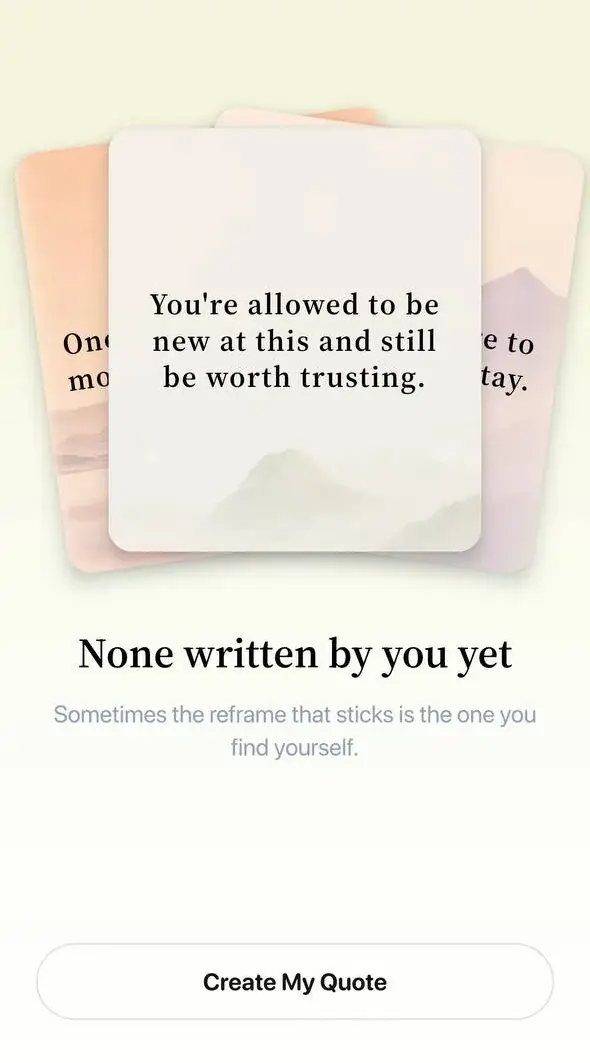
Where to Find It
Your Words is its own collection, separate from Favorites. Favorites is where you keep lines that worked; Your Words is where you make them. It's part of MindLift's free-to-start core and needs no account.
Why Write Your Own
A reframe has to be believable to do anything. Ours are written to be broadly true — yours can be exactly true. You know the name of the coworker, the specific hour it gets loud, the exact wording of the thought that keeps coming back. A line written against that specific thought has something to push against.
There's also the act itself. Writing a reframe means finding the reasonable perspective yourself, rather than reading one someone else already found. That's the skill CBT is trying to build — and it's the part that keeps working when you're nowhere near your phone.
How to Write One That Holds Up
Most people freeze at the blank card, then write something that sounds like a greeting card and never open it again. This is the order that avoids that:
A practice pad, not the app. Nothing you type here is sent or saved — when the line feels right, write it into Categories → Your Words → Create My Quote.
These are rules of thumb, not a grade. A line that fails all three and still helps you is a good line.
Three Real Comparisons
Same thought, two ways of answering it. The difference isn't tone — it's whether you'd still agree with the line on a bad day.
"I always ruin these conversations."
"I am a confident and articulate communicator."
"I rushed that one. I can slow down next time and ask a question first."
The weak version asks you to believe something you currently do not. The strong version keeps the true part and adds one thing you can actually do.
"Everyone can tell how anxious I am."
"Nobody is judging me at all."
"It feels louder inside my head than it looks from the outside."
You cannot know what nobody is thinking, so the first line gets rejected on contact. The second is checkable against your own experience.
"I didn't get anything done today."
"Every day is a gift and I am grateful for it."
"I got less done than I planned, and I was running on four hours of sleep."
Gratitude is not the counter-argument here. Context is. Naming the actual reason takes the moral weight out of the sentence.
Six Openings for When You're Stuck
Finish the sentence. The ending is the part only you can write:
The part of that I can actually control is…
It makes sense that I feel this way, because…
I don't have to decide this today. What I can do is…
I have handled something like this before, when…
I did the best I could with what I knew at the time, which was…
One hard moment does not tell me what the whole thing is, because…
Four Ways These Go Wrong
After You've Written a Few
Your Words is a collection, not an archive — it's worth revisiting. Read back through it every few weeks. Some lines will have gone flat, which usually means the thought they answered has loosened its grip. That's the outcome, not a loss. Write the one you need now.
If a line keeps proving itself, put it where you'll meet it without trying: save it to Favorites and let it rotate on the home screen widget. And if the blank card is still blank, run the thought through the Mini-Reframe first — an answer you can edit is easier than one you have to invent.
Nobody else will read what you write here. The line that helps is almost never the most eloquent one — it's the plain sentence you can still agree with when you're tired, rushed, and not feeling generous toward yourself. Write that one.