
Turn this into a daily habit — free to start in the MindLift app:
What Social Anxiety Really Is (Not What You Think)
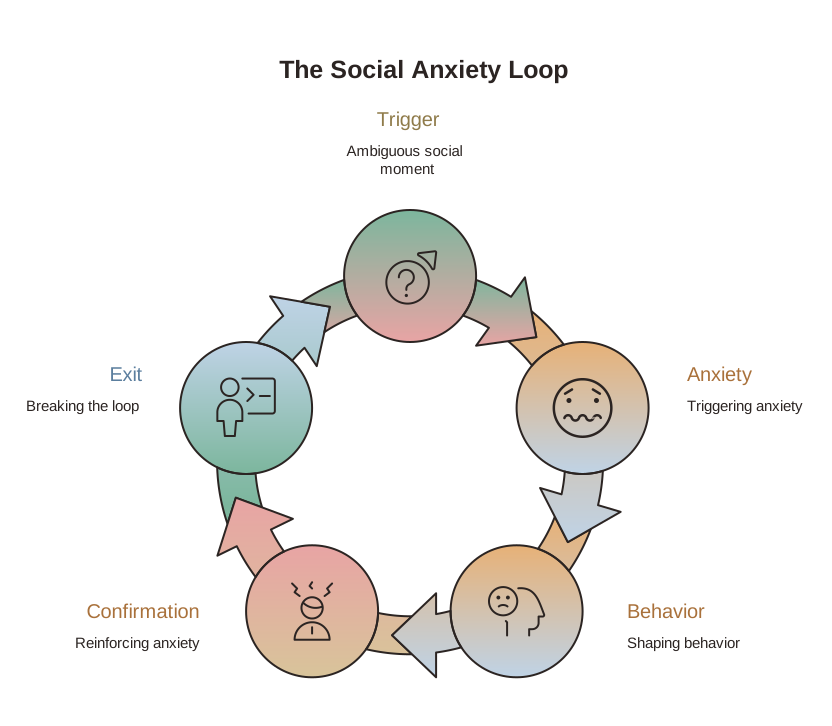
Social anxiety isn't a personality flaw. It's a loop between thoughts → feelings → behavior.
If you want to see how strong that pattern is in your own life, take the Social Anxiety Loop Quiz after you read.
CBT shows that:
- Thoughts trigger anxiety
- Anxiety shapes behavior (avoidance, overthinking)
- That behavior reinforces the thoughts
- That's the "vicious cycle" you feel stuck in
Example:
- Thought: "They think I'm awkward"
- Feeling: anxiety
- Behavior: you go quiet
- Result: feels like "proof"
Your brain goes: "See? I was right." But it wasn't truth. It was a loop.
The Hidden Villain: Cognitive Distortions
Your brain is not lying… but it is editing aggressively.
Common distortions in social anxiety:
- Mind reading → "They think I'm boring"
- Catastrophizing → "This will be embarrassing"
- Emotional reasoning → "I feel anxious = something is wrong"
- Overgeneralizing → "I was awkward once = I always am"
These are classic thinking traps that distort reality and amplify anxiety.
Reframing: The Skill That Changes Everything
Reframing is not toxic positivity. It's updating the story your brain is telling. CBT calls this: evaluating thoughts and replacing them with more realistic ones.
5 Powerful Reframes for Social Anxiety
1. From Mind Reading → Reality Checking
"They think I'm weird"
"I don't actually know what they think"
👉 Your brain is guessing, not reporting facts.
2. From Spotlight Effect → Everyone's Busy Being Themselves
"Everyone is watching me"
"Most people are focused on themselves"
👉 People are the main character in their own movie.
3. From Catastrophe → Probability
"I'll embarrass myself"
"Even if I do, it won't matter in a day"
👉 Anxiety inflates risk like a balloon. Pop it.
4. From Perfection → Human Mode
"I need to say the right thing"
"I can just be normal, not perfect"
👉 Social connection ≠ performance.
5. From Avoidance → Experiment
"I should stay quiet"
"I'll try one small thing and see what happens"
👉 CBT calls this a behavioral experiment. You're gathering evidence, not passing a test.
The 60-Second Reframe Exercise
Next time anxiety hits:
- Catch the thought → "They think I'm boring"
- Name the distortion → mind reading
- Ask: "What's the evidence for this?"
- Replace with a balanced thought → "Some people might enjoy talking to me"
This is how you rewire thinking patterns over time. And if you want more grounded phrases to use in the moment, our social anxiety affirmations list pairs well with this exercise.
Why This Works (Science in Simple Words)
Your brain is plastic. Literally. When you notice thoughts, challenge them, and replace them, you weaken old neural pathways and build new ones. Over time: anxiety softens, confidence grows, and social situations feel… normal.
The Real Goal (Not Confidence)
Most people think: "I need to feel confident first."
But CBT flips it: Act first → confidence follows.
You don't wait to feel ready. You teach your brain it's safe. This is the same principle behind not fighting your thoughts — responding differently instead.
CBT-Aligned Micro Affirmations
Grounded, believable, not fluffy:
- "Not every thought is true"
- "I can be unsure and still show up"
- "I don't need to impress to belong"
- "I'm learning how to feel more at ease"
- "This moment doesn't define me"
These reinforce adaptive thinking and emotional regulation. For more grounded statements, try our full social anxiety affirmations list.
Final Takeaway
Social anxiety isn't a personality trait. It's a pattern your brain learned. And anything learned… can be rewired.
Frequently asked questions
How do you reframe social anxiety with CBT?
Catch your anxious thought (e.g., 'They think I'm awkward'), identify the cognitive distortion (mind reading), ask 'What's the evidence?', then replace it with a balanced thought like 'I don't actually know what they think.' Repeating this process rewires neural pathways over time.
What are the most common thinking traps in social anxiety?
The four most common are: mind reading ('They think I'm boring'), catastrophizing ('This will be embarrassing'), emotional reasoning ('I feel anxious so something is wrong'), and overgeneralization ('I was awkward once so I always am').
Is reframing the same as toxic positivity?
No. Reframing doesn't deny negative feelings — it updates the story your brain is telling with more realistic, evidence-based thoughts. It's about accuracy, not forced optimism.
How long does it take to rewire social anxiety?
It varies from person to person, and there is no fixed timeline. Consistent CBT practice gradually weakens old neural pathways and builds new ones. Anxiety softens gradually as balanced thinking becomes more automatic.
Do I need to feel confident before socializing?
No — CBT flips this assumption. You act first and confidence follows. By teaching your brain it's safe through small behavioral experiments, confidence builds from experience, not from waiting to feel ready.
Like what you're reading?
Continue your wellness journey
Reframe negative thoughts in 60 seconds — free to start in the MindLift app.


Free to start · premium optional