Turn this into a daily habit — free to start in the MindLift app:
Quick Answer
Why do I overthink every conversation after it's over?
After social interactions, your brain runs an automatic threat check: 'Did that go okay? Am I still safe socially?' If anything felt ambiguous, it flags it as unresolved and keeps processing. This is a normal human mechanism — not a sign something went wrong.
The conversation ends.
You walk away. It was fine.
And then: wait, was it?
Did I talk too much? Was that joke weird? Why did they look at their phone right after I said that?
If you consistently overthink after talking to someone — even conversations that went perfectly fine — here's what's actually happening, and one question that interrupts it.
You're not oversensitive. You're not broken. This is your brain doing exactly what it evolved to do — just a little too thoroughly.
Feel embarrassed after everything you say?
You're not alone — and there's a reason it keeps happening
When does this happen most?
Why You Overthink After Talking to Someone
Every social interaction involves risk — the risk of being judged, misunderstood, or rejected. Most of the time that risk is tiny. But your brain doesn't always know that.
After the conversation ends, your brain runs a quick review: Did that go well? Am I still okay socially?
If anything felt ambiguous — a reaction you couldn't read, a moment that was slightly off — it flags it as "unresolved" and keeps processing. The loop runs until it gets an answer it trusts.
The problem: it rarely gets that answer. So it keeps running.
Why Do I Feel Embarrassed After Everything?
For some people, the review doesn't stop at "did that go okay?" — it goes straight to verdict: I said too much. I was too intense. I came across as needy.
This is an overactive inner critic applying an impossibly high standard to normal human interaction.
The bar keeps moving: you didn't say the wrong thing, but you said it wrong. You didn't say it wrong, but your timing was off. You didn't notice their timing was off because you were too distracted by whether yours was.
It's exhausting. And it's not based in reality — it's based in fear.
The Spotlight Effect (Why You're the Only One Watching)
There's a well-documented phenomenon called the spotlight effect: we dramatically overestimate how much other people notice our behavior.
You remember the exact moment you stumbled over your words. They remember the conversation generally — or they don't remember it at all.
While you're replaying the 40-second awkward moment, they're thinking about what they're having for dinner. This is the same mechanism behind replaying conversations on loop — the brain treating an ordinary interaction as an unresolved threat.
The 30-Minute Window
The highest-risk moment for post-social spiraling is the 30 minutes immediately after a conversation — especially if you're alone, tired, or in a quiet environment.
This is when the review tends to tip into self-attack. The conversation stops being analyzed and starts being prosecuted.
What you do in that window matters. Not because you can perfectly control your thoughts, but because you can interrupt the direction they're heading. At night, this window gets much longer — tiredness removes what little regulation you had left.
One Question That Breaks the Loop
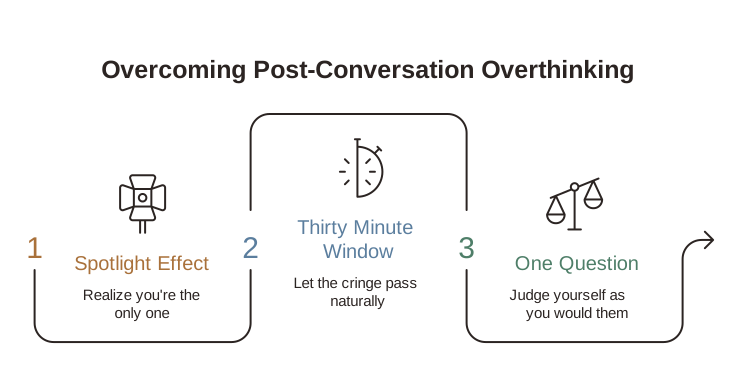
When you notice the spiral starting, ask yourself one honest question:
"What am I afraid this means about me?"
Not: "What went wrong?" That keeps you in the spiral.
But: "What am I afraid this means?"
The answer is usually something like: "I'm afraid they think I'm boring." Or: "I'm afraid I came across as too much."
Once you name the fear, you can address it directly with something honest and believable:
"Maybe I came across as a lot — or maybe they just had a long day. I genuinely can't know. And most people are too focused on their own performance to judge mine."
That's not toxic positivity. That's accurate thinking.
What Changes Over Time
The first time you try this, it'll feel forced and the spiral will probably come back.
Keep going. You're not trying to eliminate the post-conversation review — that's normal human behavior. You're training it to be less punishing.
Over time:
— the review gets shorter
— the verdict gets less harsh
— you recover faster
If the spiral is happening right now, these 3 interruptions work faster than the usual advice.
Final Thought
Overthinking after talking to someone doesn't mean you're socially incompetent. It means your brain is being overprotective.
The goal isn't to never review a conversation. It's to review it like a coach — not a prosecutor.
Frequently asked questions
Why do I overthink after talking to someone?
After social interactions, your brain reviews what happened for potential threats to your social standing. If anything felt ambiguous — a pause, a reaction you couldn't read — it keeps processing it. This is normal human wiring, not a sign something went wrong.
Why do I feel embarrassed after everything I say?
Feeling embarrassed after everything often traces back to an overactive inner critic that judges your behavior against an impossibly high standard. Each interaction gets evaluated for mistakes, and the bar keeps moving. This is learned — and it can be unlearned with deliberate practice.
Is it normal to overthink every conversation?
Mild post-conversation reflection is completely normal and even useful — it helps you learn. What tips into overthinking is when the review turns into self-attack ('I'm so awkward') or lasts so long it interferes with your day.
How do I stop overanalyzing interactions?
The most effective approach: catch the specific fear underneath the replay ('I'm afraid they think I'm boring') and shift it slightly to something believable ('They might not have thought much of it either way — I can't know'). This gives your brain the 'all clear' signal it's looking for.
Why do I feel anxious after social situations even when they went well?
Post-social anxiety can happen even after genuinely good interactions. For people with social anxiety or an overactive inner critic, the brain defaults to threat-scanning regardless of how the situation actually went. Over time, consistently challenging this pattern weakens the automatic response.
Like what you're reading?
Stop the spiral in real time
MindLift gives you a gentle CBT-based reframe the moment your thoughts start looping.


Free to start · no account required
CBT & Self-Talk Researchers
MindLift content is grounded in cognitive behavioral therapy principles and designed to help you shift harsh self-talk in real time. Our guides focus on practical, evidence-based techniques you can use in the moment.
Was this article helpful?