
Turn this into a daily habit — free to start in the MindLift app:
You've probably seen them everywhere — "I am enough," "I choose peace," "I believe in myself." Daily affirmations aren't just Instagram quotes: research on self-affirmation theory and CBT shows a specific, believable version of this practice can genuinely reshape how you think. Here's the science behind why — and what makes affirmations work versus fall flat.
What are daily affirmations?
Daily affirmations are short, positive statements you repeat to yourself to challenge negative thoughts and reinforce self-belief. Psychologists describe them as 'adaptive self-talk' — a way to strengthen helpful beliefs and reduce the power of unhelpful or distorted thinking. Research links consistent practice to activation in the brain's self-processing and reward systems, and to reduced stress reactivity.
Cascio et al. (2016); Sherman et al. (2009)
What Are Daily Affirmations?
Daily affirmations are short, positive statements you repeat to yourself to challenge negative thoughts and reinforce self-belief. Psychologists describe them as "adaptive self-talk" — a way to strengthen helpful beliefs and reduce the power of unhelpful or distorted thinking. For example:
- Negative thought: "I'll never be good enough."
- Daily affirmation: "I'm learning to see progress, not perfection."
Over time, repeating grounded, believable affirmations is thought to shape the brain's neural pathways toward optimism and resilience — a process known as neuroplasticity, the brain's ability to reorganize itself by forming new connections throughout life. In the context of affirmations, it's the mechanism through which repeated, believable self-talk can gradually reshape thought patterns.
The Science Behind Affirmations
Research in cognitive and positive psychology shows that self-affirmations activate the brain's valuation and self-processing systems — the ventral striatum and medial prefrontal cortex — regions tied to motivation and self-worth (Cascio et al., 2016). In other words, your brain shows measurable activity when you remind yourself of what matters most.
Studies also link self-affirmation practice to:
- Reduced sympathetic nervous system stress responses under pressure (Sherman et al., 2009)
- Better problem-solving under stress (Creswell et al., 2013)
- Greater openness to behavior change and psychological resilience (Cohen & Sherman, 2014)
- A wider view of yourself, so one threat (a bad review, a failed exam) takes up less of the picture (Critcher & Dunning, 2015)
When paired with CBT techniques — like thought-challenging or behavioral experiments — affirmations go from "feel-good words" to evidence-informed tools for mindset change.
How CBT and Affirmations Work Together
CBT, developed by Aaron and Judith Beck, is based on a simple idea:
"The way you think affects how you feel — and how you act."
Affirmations complement this process by reinforcing balanced, realistic self-talk after you identify and challenge distorted thoughts. For example:
- CBT Thought Challenge: "I failed this task — I'm worthless."
- Balanced Thought: "I made a mistake, but that doesn't define my worth."
- Affirmation: "I can learn from this and try again."
Why Daily Practice Matters
Consistency is key. Repetition is thought to help strengthen positive neural networks, reducing defensive reactions to stress. Practicing affirmations once won't undo years of self-criticism — but doing it daily helps recondition how you interpret challenges.
The best affirmations are:
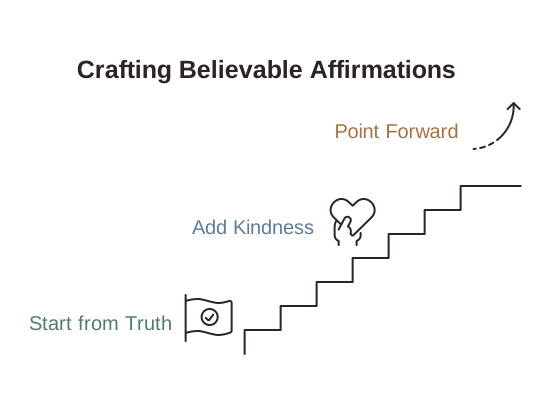
- Believable: Grounded in your current reality.
- Specific: Focused on a real goal or emotion.
- Emotionally resonant: They make you feel something true.
Examples:
- "Not every thought needs solving."
- "I can face uncertainty, one step at a time."
- "I'm working on being kinder to myself."
How to Write Your Own (Without It Sounding Fake)
A sentence you wrote from your own situation beats one you borrowed. These three shapes acknowledge the hard part before offering the alternative, which is what stops your brain from rejecting the sentence outright:
- "Even though ___, I can ___." — "Even though I feel behind, I can do the next hour's work." The first half buys credibility for the second.
- "I'm learning to ___." — "I'm learning to let a message sit unanswered without assuming the worst." Progress, not arrival, so it stays true on bad days.
- "Right now, I can ___." — "Right now, I can breathe, send one email, and reassess at noon." Shrinks the timeframe until the claim is obviously true.
None of these promise an outcome. They describe something you can actually do, which is what makes them hold up mid-spiral rather than only when you're calm.
How to Start Your Affirmation Practice Today
Choose 3-5 personal affirmations
Select affirmations that resonate with your specific goals. Make them present-tense, positive, and personal (e.g., 'I am confident in my abilities' rather than 'I will be confident').
Set a consistent schedule
Practice morning (upon waking) and evening (before bed), about 5-10 minutes each time. Set phone reminders for consistency — the brain is most receptive to affirmations during these times.
Speak with intention and emotion
Say affirmations out loud while looking in a mirror. Engage emotionally — visualize the affirmation being true.
Track your progress
Use the MindLift app or a journal to track mood changes and wins. Tracking tends to help people stick with a new practice.
Adjust and evolve
After a few weeks, review what's working. Update affirmations as you grow — they should evolve with your personal development journey.
The Modern Way to Practice: MindLift
While paper journaling or mirror affirmations work, today's technology allows something more personalized. MindLift uses an AI + CBT model to deliver personalized affirmations and mini-reframes tailored to your mood and goals:
- CBT-inspired affirmations: Rooted in cognitive science, not generic quotes.
- Mood-adaptive personalization: Whether you feel anxious, low, or confident — MindLift meets you there.
- Mini-Reframe Chat: A 60-second CBT-based flow that helps calm spirals in real time.
- Audio listening mode: Hear your affirmations aloud.
- Daily self-love plan: Small, consistent steps to help you internalize growth.
Final Thoughts
Daily affirmations aren't magic — they're mental training. When done right, they help you move from self-criticism to self-compassion, from overthinking to calm confidence. Because the truth is:
You don't have to chase every thought. You just have to learn to guide them.
For more on making the practice stick, see how to build a morning affirmation routine that actually works and what the science says about reprogramming your mind.
MindLift builds daily affirmations into a personalized CBT-based practice — pick your mood, get a believable affirmation, and reframe the thought behind it in about 60 seconds. Free to start, premium available. Try MindLift — free to start →
Frequently asked questions
Do affirmations really rewire your brain?
Yes, according to neuroscience research. Repeating affirmations activates brain regions associated with self-processing and reward, strengthening positive neural pathways through neuroplasticity. Studies show that consistent practice is linked to measurable changes in brain activity over time.
How long before affirmations work?
It varies from person to person, and there is no fixed timeline — with consistent daily practice, the shift builds gradually. The key is practicing believable affirmations daily as part of your routine.
What's the best time to practice daily affirmations?
The morning is ideal because your mind is most receptive after waking. However, consistency matters more than timing. Many people benefit from practicing affirmations multiple times daily—morning for intention-setting, midday for stress relief, and evening for reflection.
Can affirmations help with anxiety and depression?
Yes, when used as part of a comprehensive approach. Research shows affirmations boost psychological resilience, improve emotional regulation, and reduce defensive stress responses. They're most effective when combined with evidence-based therapies like CBT and professional support when needed.
Does it matter if I say affirmations out loud or silently?
Both work. Saying affirmations out loud engages more of the brain — auditory processing and motor regions — which some research links to stronger encoding, but silent repetition still counts as consistent practice. Use whichever you'll actually keep up.
Are affirmations just a placebo effect?
No. Brain-imaging studies show self-affirmation activates measurable neural circuits tied to self-processing and reward — the ventral striatum and medial prefrontal cortex — not just a story you tell yourself. That doesn't mean affirmations replace therapy or professional support; it means the underlying mechanism is real, not imaginary.
Like what you're reading?
Continue your wellness journey
Reframe negative thoughts in 60 seconds — free to start in the MindLift app.


Free to start · premium optional